Introduction
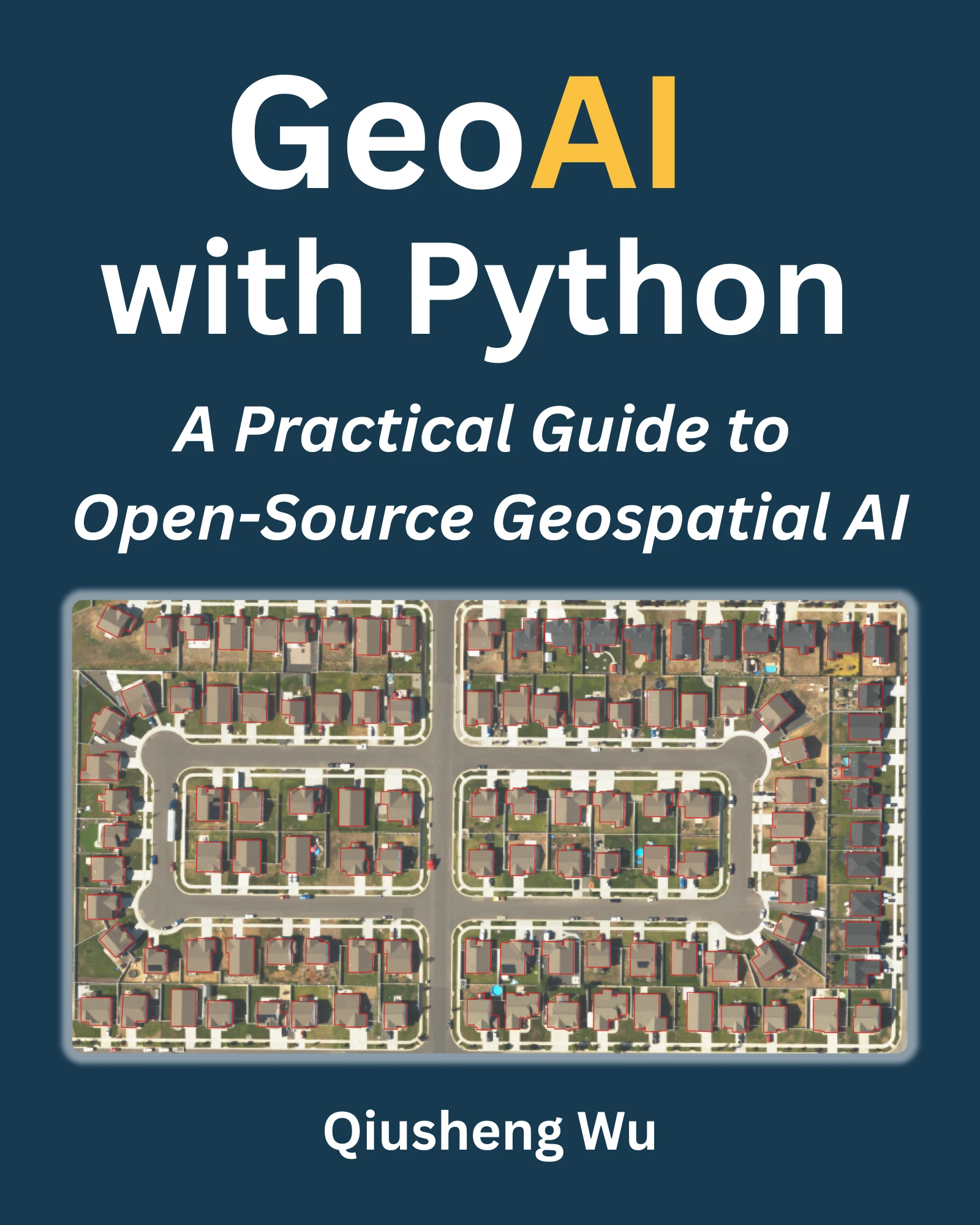
Welcome to the official repository for GeoAI with Python: A Practical Guide to Open-Source Geospatial AI. This repository contains all the code examples featured in the book, designed to help you learn and apply GeoAI using open-source tools.
Get the Book
Print Edition
🇺🇸 Englsih Full-Color Print Edition (430 pages) is available on Amazon (link)
PDF and EPUB Editions
🇺🇸 English | 🇲🇽 Spanish | 🇨🇳 Chinese | 🇫🇷 French | 🇩🇪 German | 🇯🇵 Japanese | 🇰🇷 Korean | 🇮🇩 Indonesian | 🇵🇹 Portuguese | 🇷🇺 Russian | 🇮🇹 Italian
Cite the Book
If you use this book in your research or teaching, please consider citing it as follows:
Wu, Q. (2026). GeoAI with Python: A Practical Guide to Open-Source Geospatial AI. Independently published. PDF edition ISBN 979-8993859729; Print edition ISBN 979-8253507414. Available at book.opengeoai.org.
About This Book
Learn to apply deep learning and AI to satellite imagery, aerial photos, and geospatial data using Python. This practical, hands-on guide walks you from downloading remote sensing data to training and evaluating deep learning models, all using open-source tools.
What you’ll learn
Set up a complete GeoAI environment with Python, PyTorch, and GPU acceleration.
Download satellite imagery from Microsoft Planetary Computer and open data portals.
Create interactive maps and prepare training datasets from large satellite images.
Train and evaluate models for seven core geospatial AI tasks: image recognition, object detection, semantic segmentation, instance segmentation, image translation, change detection, and pixel-level regression.
Apply foundation models, including the Segment Anything Model (SAM), vision-language models, and satellite embeddings, to real-world Earth observation problems.
Run AI workflows in QGIS without writing code using plugins for tree segmentation, water detection, and more.
Structure and format
23 chapters of executable code examples organized in five parts: Foundations, Data Acquisition and Preparation, Core AI Tasks, Foundation Models, and QGIS Plugins.
All examples use real satellite imagery with PyTorch, torchgeo, segment-geospatial, leafmap, and geoai.
All code and datasets are freely available on GitHub and Source Cooperative for full reproducibility.
Who it’s for
GIS professionals, remote sensing scientists, data scientists, and students who want to apply AI to geospatial data using Python and open-source tools.
Table of Contents
Preface
Part I: Foundations
Part II: Data Acquisition and Preparation
Part III: Core AI Tasks
Part IV: Foundation Models and Satellite Embeddings
Part V: QGIS Plugins
About the Author
Dr. Qiusheng Wu is an Associate Professor and the Director of Graduate Studies in the Department of Geography & Sustainability at the University of Tennessee, Knoxville. He also serves as an Amazon Scholar. Dr. Wu’s research focuses on advancing open-source geospatial analytics through cloud computing and GeoAI, with an emphasis on leveraging big geospatial data and artificial intelligence to study environmental change, particularly surface water and wetland inundation dynamics.
He is the creator and maintainer of several widely used open-source Python packages, including geemap for interactive Google Earth Engine visualization, leafmap for versatile geospatial mapping, segment-geospatial for applying the Segment Anything Model to geospatial data, and geoai for high-level GeoAI workflows. His open-source projects, available through the Open Geospatial Solutions organization on GitHub, have been widely adopted by researchers, educators, and practitioners worldwide.
Dr. Wu’s work bridges remote sensing, Earth observation, and artificial intelligence to make large-scale geospatial data more accessible, reproducible, and intelligent. He is passionate about open science and believes that the best tools for understanding our planet should be freely available to everyone.
Licensing and Copyright
This book embraces the principles of open science and open education. To support transparency, learning, and reuse, the code examples in this book are released under a Creative Commons Attribution 4.0 International (CC BY 4.0) license. This means you are free to copy, modify, and distribute the code, even for commercial purposes, as long as appropriate credit is given.
Please attribute code usage by citing the book or linking to the GitHub repository:
Wu, Q. (2026). GeoAI with Python: A Practical Guide to Open-Source Geospatial AI. Independently published. PDF edition ISBN 979-8993859729; Print edition ISBN 979-8253507414. Available at book.opengeoai.org.
While the code is freely available, the text, figures, and images in this book are copyrighted © 2026 by the author and may not be reproduced, redistributed, or modified without explicit permission. This includes all written content, custom diagrams, and embedded visualizations unless otherwise noted.
If you wish to reuse or adapt any non-code material from the book (for example, for teaching, presentations, or publications), please contact the author to request permission.
This dual licensing approach helps balance open access to learning materials with the protection of original creative work. Thank you for respecting these terms and supporting the open-source geospatial community.